


Executive Summary: Khula and Divorce in Karachi in Brief
What the guide covers
Four ways a Muslim marriage registered in Pakistan can end during the spouses' lifetime: talaq pronounced by the husband, khula decreed by the family court, judicial dissolution under the Dissolution of Muslim Marriages Act 1939, and talaq-e-tafweez exercised by the wife under a delegated right recorded in the Nikah Nama.
Who needs this comparison
Wives who want to leave a marriage, husbands who intend to divorce correctly, and families who have heard conflicting advice. It is particularly useful where a verbal talaq was given without notice, or where the wife is unsure whether her Nikah Nama gave her a delegated right of divorce.
Fee basis
Fees depend on the route. A talaq notice or delegated divorce involves drafting and Union Council follow-up, while a contested suit involves hearings and evidence. The fee is quoted after the documents are reviewed, and you know the cost of each stage before you commit.
Usual time frames
Talaq and delegated divorce follow a statutory notice period of ninety days before they become effective. Khula may be decreed within a few months if reconciliation fails. Judicial divorce on contested grounds can take longer. These are ranges only and are never guaranteed.
How to start
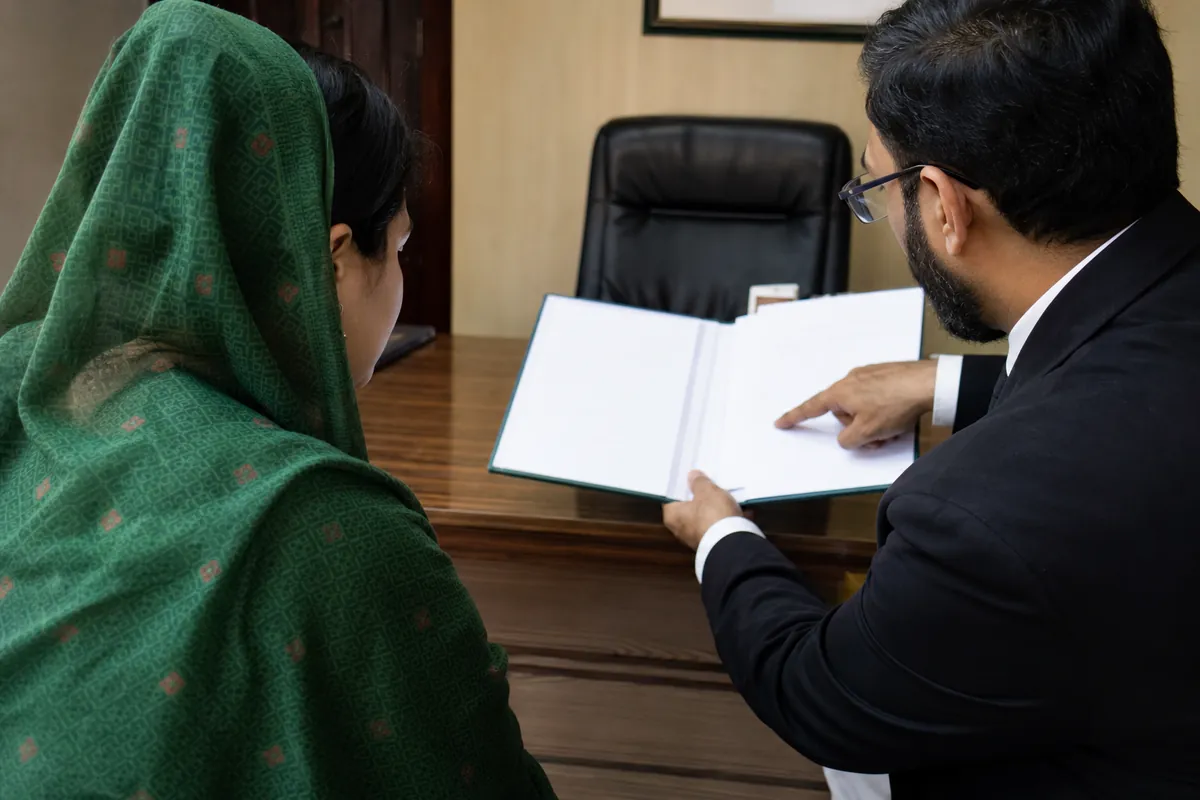
Send the Nikah Nama, both CNICs if available, and a short note of what has happened on WhatsApp. We confirm the facts, identify the right route and list the documents needed, then arrange a private call or a meeting at either office.
Advocate-led since 1985
Our family team works within an advocate-led practice founded in 1985. Sobia Mohsin, Family Law Expert, and Tahir Pervez Qureshi, Advocate High Court, handle this work in Karachi, with senior supervision available for contested and appellate matters.
The four routes to Khula and Divorce in Karachi
Talaq by the husband
A husband who pronounces talaq must, under section 7 of the Muslim Family Laws Ordinance 1961, give written notice to the Chairman of the Union Council and send a copy to the wife. The talaq becomes effective ninety days after the notice is delivered, unless revoked earlier.
Khula through the family court
A wife who cannot live with her husband within the limits prescribed by Allah may sue for khula. The Family Courts Act 1964 requires the court to attempt reconciliation; if that fails, the court can decree dissolution, and may require the wife to forgo dower or return benefits received.
Judicial divorce on statutory grounds
The Dissolution of Muslim Marriages Act 1939 lets a wife seek dissolution on grounds such as cruelty, failure to maintain, desertion or a second marriage without the required permission. If a ground is proved, the wife does not have to give up her dower as she might in khula.
Delegated divorce (talaq-e-tafweez)
If the Nikah Nama delegates the right of divorce to the wife, she may pronounce divorce herself. Section 8 of the 1961 Ordinance applies the same notice procedure: written notice to the Union Council Chairman, a copy to the husband, and a ninety-day period before it takes effect.
Comparing the routes to Khula and Divorce in Karachi
| Route | Who starts it | Where | Main law | Dower position | Usual time |
|---|---|---|---|---|---|
| Talaq | Husband | Union Council | MFLO 1961, s.7 | Unpaid dower becomes payable | 90 days after notice |
| Khula | Wife | Family court | Family Courts Act 1964 | Wife may have to forgo dower or return benefits | A few months if uncontested |
| Judicial divorce | Wife | Family court | Dissolution of Muslim Marriages Act 1939 | Dower generally preserved if ground proved | Longer; depends on evidence |
| Delegated divorce | Wife, under the Nikah Nama | Union Council | MFLO 1961, s.8 | Unpaid dower generally remains payable | 90 days after notice |
Which route fits your situation
- The Nikah Nama gives the wife a delegated right: delegated divorce is often the quickest and avoids a suit.
- The husband is cruel, has stopped maintenance or has married again without permission: consider judicial divorce to protect dower.
- The wife simply cannot continue and no fault ground can easily be proved: khula is usually the practical route.
- The husband wants to end the marriage: a properly drafted talaq notice to the Union Council is essential.
- Both spouses agree: a mutual arrangement can be recorded, but the notice procedure must still be followed.
How the ninety-day Union Council process works
- The talaq or delegated divorce is pronounced and recorded in a written deed or notice.
- Written notice is delivered to the Chairman of the Union Council concerned, with a copy to the other spouse.
- Within thirty days, the Chairman constitutes an Arbitration Council to attempt reconciliation.
- If reconciliation fails or the parties do not attend, the divorce becomes effective after ninety days from delivery of notice; if the wife is pregnant, not until the pregnancy ends, if later.
- The Union Council issues a certificate confirming that the divorce has become effective, which is then used for NADRA records.
What happens after a khula decree
Once the family court passes a decree for dissolution by khula, a copy is sent to the Union Council concerned, and the parties follow the Union Council process for the certificate of effectiveness. We obtain certified copies of the decree and follow up so that NADRA marital status can be updated.
Grounds for judicial Khula and Divorce in Karachi under the 1939 Act
- The husband's whereabouts have not been known for four years.
- He has failed to provide maintenance for two years.
- He has taken another wife in contravention of the Muslim Family Laws Ordinance 1961.
- He has been sentenced to imprisonment for seven years or more.
- He has failed without reasonable cause to perform his marital obligations for three years.
- Cruelty, including habitual assault or conduct making the wife's life miserable.
- Any other ground recognised as valid for dissolution under Muslim law.
Each ground has its own proof requirements. We assess the evidence before recommending judicial divorce, because an unproved ground can leave the wife with a khula decree and a reduced dower claim.
Dower, maintenance and children after Khula and Divorce in Karachi
Whatever the route, the wife may still claim unpaid dower (subject to any khula terms), maintenance for the iddat period where applicable, and return of her dowry articles. The children's maintenance remains the father's duty, and custody is decided separately on the welfare of each child.
These claims are often joined in one family suit, which saves time. Where talaq was given by the husband, the wife files her own suit for dower, maintenance and dowry, and custody can be pursued before the family court acting as guardian court.
Reconciliation and settlement in Khula and Divorce in Karachi
Every route includes a chance to reconcile. In talaq and delegated divorce, the Arbitration Council meets the spouses; in khula and judicial divorce, the family court attempts reconciliation before trial. Reconciliation is not a formality, and some couples do resume married life. Where they do not, it is often the best moment to settle money and children.
A settlement recorded before the court or the Arbitration Council can cover dower, the return of dowry articles, maintenance for the children and a meeting schedule. A clear written settlement saves months of evidence, but it must be fair and freely agreed. We review every proposed term before a client signs.
Timing and distance
Iddat and the effective date
The iddat period follows the divorce and generally lasts three menstrual cycles, or until delivery if the wife is pregnant. During this period the wife is usually entitled to maintenance, and she may not remarry. Knowing the effective date matters for remarriage, inheritance and the NADRA record, so we confirm it in writing.
Spouses living abroad
Where one spouse lives overseas, notices can be signed before a Pakistani mission and delivered in Karachi, and suits can proceed through an attorney appointed by a properly attested power of attorney. Personal attendance may still be needed for reconciliation or evidence. We plan the steps so that travel is kept to a minimum.
Verbal talaq without notice
Many clients tell us the husband said "talaq" three times and left. Pakistani law requires written notice to the Union Council, and failure to give it is an offence under the 1961 Ordinance. Whether and when such a divorce becomes effective in law needs careful advice on the facts before either spouse remarries.
Documents for Khula and Divorce in Karachi
- Nikah Nama, especially column 18 on delegation of the right of divorce.
- CNICs of both spouses and the children's B-Forms.
- Any talaq deed, notice or Union Council correspondence already issued.
- Evidence of the ground relied on, such as medical reports or proof of non-maintenance.
- List of dowry articles and gold, and details of dower paid or unpaid.
Get the route right before you act
One message can save months. Send your Nikah Nama and we will tell you which route suits you, what it will involve and what it will cost. See also our pages on divorce rights in Pakistan, dowry recovery and lady lawyers for women clients.
Frequently asked questions
What is the difference between khula and talaq?
Talaq is pronounced by the husband and becomes effective through the Union Council notice process. Khula is sought by the wife from the family court, which decrees dissolution if reconciliation fails. In khula, the court may ask the wife to forgo dower or return benefits she received, so the choice of route has real financial consequences.
How do I know whether I have a delegated right of divorce?
Check column 18 of your Nikah Nama. If it records that the right of divorce has been delegated to the wife, and on what conditions, she can usually exercise it herself through the Union Council. Send us a clear copy and we will read the wording for you.
Is a verbal triple talaq valid in Pakistan?
The Muslim Family Laws Ordinance 1961 requires written notice to the Union Council Chairman, and failure to give notice is an offence. The legal effect of an unnoticed talaq depends on the facts, so take advice before either spouse remarries or relies on it.
How long does Khula and Divorce in Karachi take?
Talaq and delegated divorce follow a ninety-day period after notice. Khula may be decreed within a few months if reconciliation fails early. Judicial divorce on contested grounds usually takes longer. None of these periods can be guaranteed, as court diaries and service on the other side vary.
Can I claim dower if I file for khula?
Possibly. The court may require a wife seeking khula to forgo all or part of the dower, depending on the facts. If the husband is at fault, a judicial divorce suit on a statutory ground may better protect the dower. We assess this before you file.
Does my husband have to agree to khula?
No. Khula is decreed by the family court, and the husband's consent is not required. He is served with notice and may attend reconciliation, but if reconciliation fails the court can dissolve the marriage despite his opposition.
Where is a khula suit filed in Karachi?
Usually in the family court of the district where the wife ordinarily resides. Karachi has family courts in each district, including at the City Courts complex and the Malir courts. We confirm the correct court before filing.
Can a husband give talaq from abroad?
Yes, but he must still give written notice to the Union Council Chairman concerned and send a copy to the wife. The notice is normally signed before the Pakistani mission or properly attested. We can deliver and follow up the notice in Karachi.
Who handles khula and divorce cases at your firm?
Sobia Mohsin, Family Law Expert, and Tahir Pervez Qureshi, Advocate High Court, lead this work, with Syed Akhtar Rizvi, Advocate Supreme Court, available for contested and appellate matters. You will know from the start who is responsible for each stage.
What does a divorce case cost?
The fee depends on the route and on whether dower, maintenance, dowry or custody claims are joined. It is quoted after the documents are reviewed, and you receive the quotation before anything is filed or any notice is sent.
Speak to Karachi Lawyers about Khula and Divorce in Karachi
Karachi Lawyers has practised since 1985 and has about 17 advocates, including two Advocates Supreme Court. Send a WhatsApp message to +92 333 1127830 with your name, a two-line summary of the matter, any deadline or hearing date, and photos of the key documents. We will tell you what the law requires, which documents are missing and what the next step is, and fix an appointment at our Gulistan-e-Jauhar office (Mezzanine Floor, Muneer Mobile Mall, Block 17) or our DHA office (Mezzanine Floor, Main Jami Commercial, Phase 7). We explain the scope of work before you instruct us, and we never promise an outcome we cannot control.
Related services from Karachi Lawyers
Official sources
For reference only. Procedures and charges change; confirm the current position for your own case.
This page gives general information about the law in Pakistan and is not legal advice for your particular case. No outcome, timeline or fee can be guaranteed before your documents and circumstances have been reviewed.
Reviewed by: Syed Akhtar Rizvi, Advocate Supreme Court
Published by: Karachi Lawyers
Last updated: