Executive Summary: Divorce Rights in Pakistan
What this advice covers
The financial and family rights of the wife and the husband when a Muslim marriage ends by talaq, khula, judicial divorce or delegated divorce: dower, iddat and past maintenance, dowry and personal property, children's custody and maintenance, and the right to remarry. Non-Muslim marriages are governed by other laws and need separate advice.
Who needs it
Wives considering khula or facing talaq, husbands intending to divorce, parents of either spouse, and overseas Pakistanis whose marriages were registered in Pakistan. It is also useful for anyone negotiating a settlement who wants to know what the court would likely recognise.
Fee basis
A written opinion, a negotiated settlement and a contested suit carry different fees. In every case the fee is quoted after the documents are reviewed, and we explain the stages so that you can decide how far to go.
Time involved
Advice can usually be given within days of receiving documents. Court claims for dower, maintenance or custody take months, more if contested. Talaq and delegated divorce run ninety days from notice. No outcome or time is guaranteed.
How to start
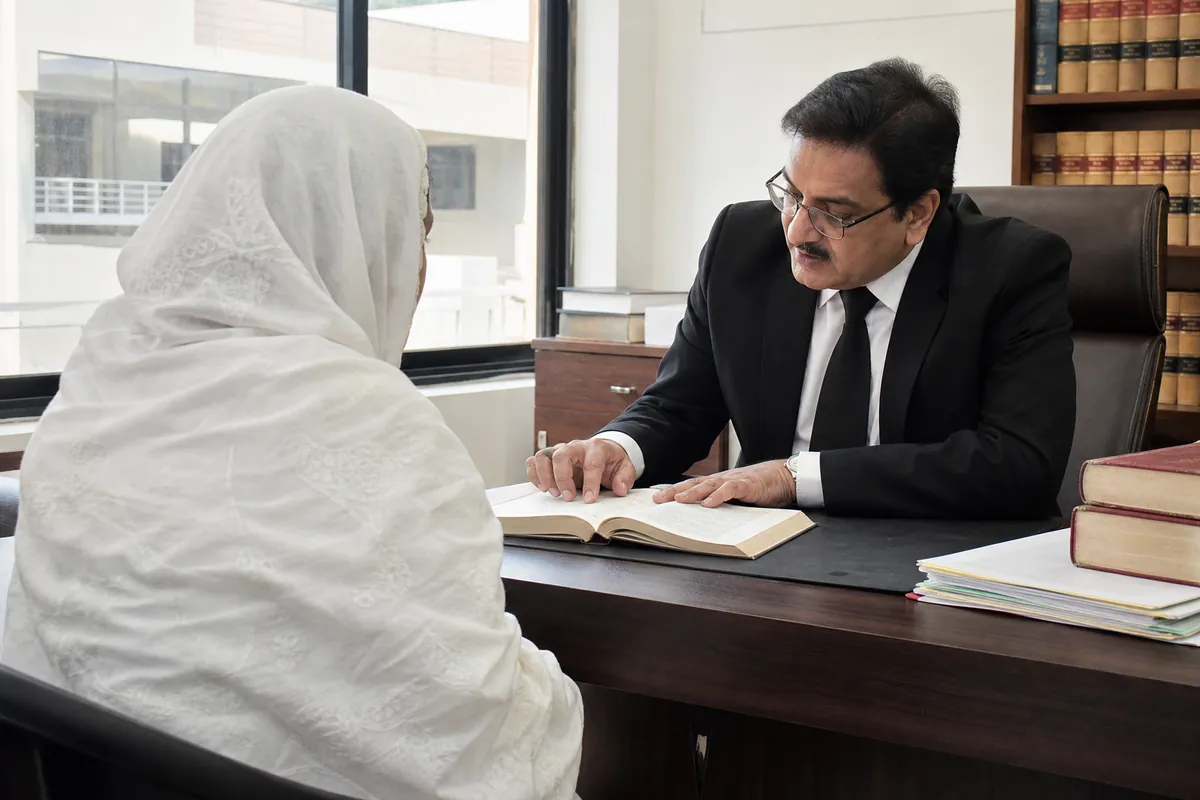
Send the Nikah Nama, CNICs, children's B-Forms and a short summary on WhatsApp. We will tell you which rights are engaged and which documents prove them, then arrange a call or an office meeting.
Advocate-led since 1985
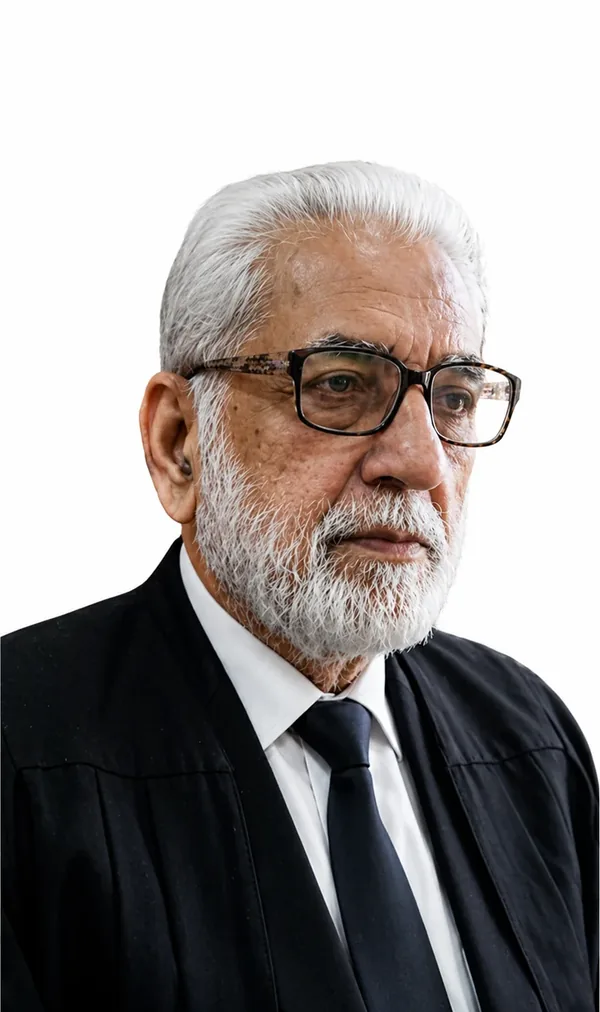
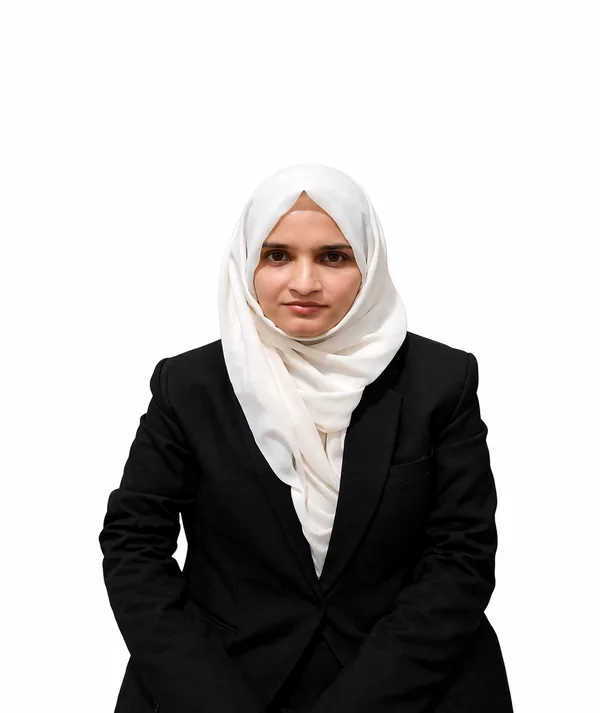
Advice is supervised by Syed Akhtar Rizvi, Advocate Supreme Court, with Sobia Mohsin, Family Law Expert, working closely with clients, within a practice that has handled family matters since 1985.
Divorce Rights in Pakistan begin with the Nikah Nama
The Nikah Nama records the dower, how it is to be paid, any property given in lieu of dower, whether the wife has a delegated right of divorce, and any conditions agreed between the spouses. Before advising on rights, we read every column, because a single entry can change which route and which claims are open.
The wife's Divorce Rights in Pakistan
Dower
Unpaid dower is a debt the husband owes the wife. On talaq, deferred dower becomes payable. In khula, the court may require the wife to give up all or part of it. In judicial divorce on a proved ground, dower is generally preserved.
Maintenance during iddat and arrears
A divorced wife is generally entitled to maintenance during the iddat period, and may claim maintenance for any earlier period in which the husband failed to maintain her, subject to proof and the court's assessment.
Dowry and personal property
Dowry, bridal gifts and the wife's personal belongings remain hers under the Dowry and Bridal Gifts (Restriction) Act 1976 and can be recovered through the family court, or their value.
The right to remarry
After the divorce becomes effective and the iddat ends, the wife may remarry. Under section 7(6) of the 1961 Ordinance she may remarry the same husband without an intervening marriage, unless the divorce was effective for the third time.
The husband's Divorce Rights in Pakistan
Pronouncing talaq lawfully
A husband may pronounce talaq, but must give written notice to the Union Council Chairman with a copy to the wife. He may revoke it before it becomes effective. Failure to give notice is an offence under the Ordinance.
Benefits returned in khula
Where the wife obtains khula, the court may order her to forgo dower or return benefits received from the husband. He may place evidence of what was given before the court, and the court decides what, if anything, must be returned.
Guardianship and access
The father remains the natural guardian of his children's person and property, even while young children live with their mother. He is entitled to seek visitation, and in suitable cases custody, through the guardian court.
Divorce Rights in Pakistan side by side
| Issue | Wife | Husband | Main source of law |
|---|---|---|---|
| Dower | Recover unpaid dower; may forgo it in khula | Pay unpaid dower; may seek return of benefits in khula | MFLO 1961; Family Courts Act 1964 |
| Maintenance | Iddat maintenance and proven arrears | Liable for iddat maintenance and arrears | Muslim personal law; Family Courts Act 1964 |
| Dowry and gifts | Return of dowry and bridal gifts or value | No right to retain them | Dowry and Bridal Gifts (Restriction) Act 1976 |
| Children | Custody (hizanat) of young children, subject to welfare | Natural guardian; visitation; custody in suitable cases | Guardians and Wards Act 1890 |
| Child maintenance | Claim it on the children's behalf | Liable to maintain the children | Family Courts Act 1964 |
| Remarriage | After the divorce is effective and iddat ends | Free to remarry once the divorce is effective | MFLO 1961 |
Iddat and why it matters for Divorce Rights in Pakistan
Iddat is the waiting period after divorce, generally three menstrual cycles, or until delivery if the wife is pregnant. During iddat the wife is usually entitled to maintenance and may not remarry. Where the wife is pregnant, the divorce itself does not take effect until the ninety-day period or the pregnancy ends, whichever is later.
Settlements between spouses
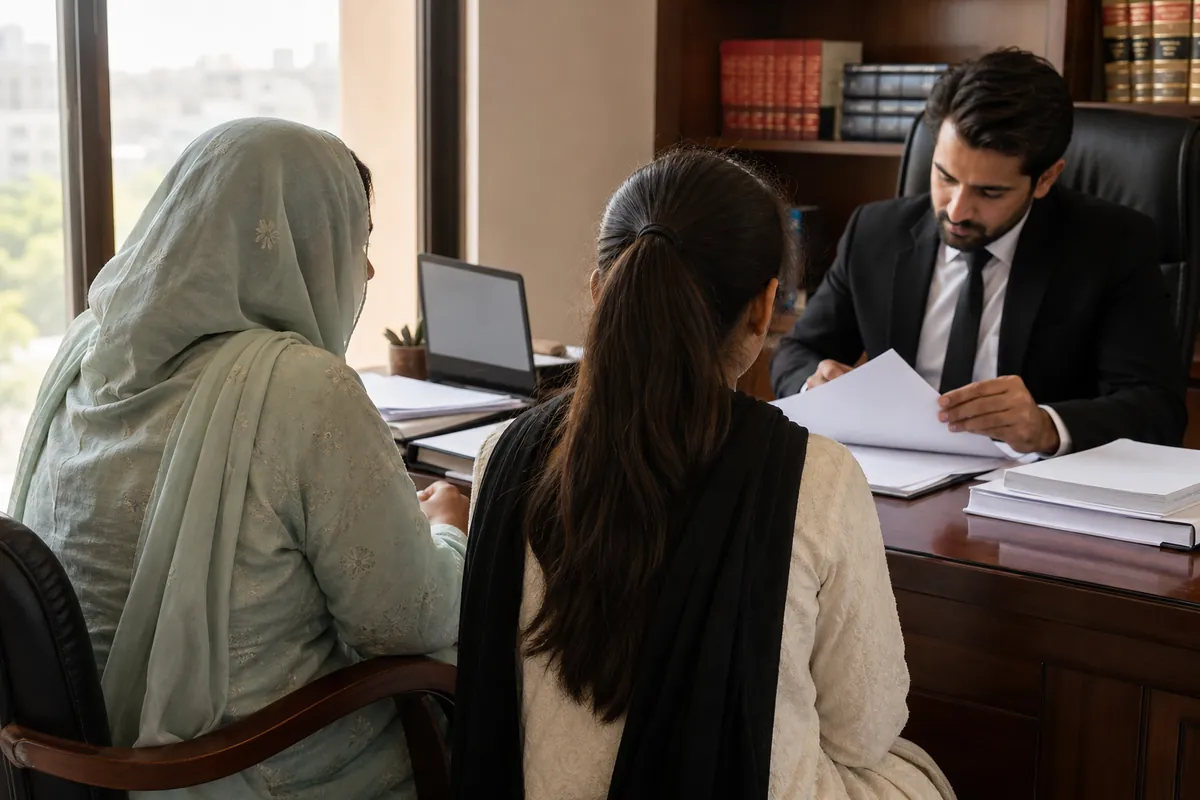
Many divorces end with a settlement on dower, dowry articles, child maintenance and visitation. A settlement can be recorded before the Arbitration Council or the family court. It should be specific, with amounts, dates and a meeting schedule, because vague promises are hard to enforce. We review proposed terms so that neither spouse gives up rights unknowingly.
Documents that prove each right
- Nikah Nama, for dower, its mode of payment and any delegated right of divorce.
- Talaq deed, Union Council notice or court decree, for the date of divorce.
- Receipts, photographs and witnesses, for dowry and bridal gifts.
- Evidence of the husband's income, for maintenance claims.
- Children's B-Forms, school and medical records, for custody and child maintenance.
Mistakes that weaken a spouse's position
- Signing a settlement or "khula nama" without reading what is being given up.
- Remarrying before the Union Council certificate is issued and iddat has ended.
- Removing children from the other parent without a court order.
- Relying on a verbal talaq without written notice to the Union Council.
- Leaving financial claims for years until evidence has been lost.
Children after divorce
Divorce ends the marriage, not the parents' duties. The father must maintain the children whoever has custody. The family court, acting under the Guardians and Wards Act 1890, decides custody on the welfare of each child and fixes visitation. See our guide on child custody rights.
After the divorce: property and records
Property after divorce
Pakistani Muslim family law has no community-property rule. Each spouse keeps the property in his or her own name, and the husband's house or business is not divided on divorce. The wife's claims are for dower, maintenance, dowry and her own belongings. Property given in lieu of dower is a separate matter recorded in the Nikah Nama.
The Union Council certificate and NADRA records
Once the ninety-day period has run, the Union Council issues a certificate confirming the divorce has become effective. This is needed to update marital status with NADRA and for remarriage, travel and inheritance records. We follow up the certificate so that the paperwork matches the legal position.
Divorce involving overseas Pakistanis
A husband abroad can give talaq through a written notice attested at the Pakistani mission and sent to the Union Council concerned. A wife abroad can file through an attorney under a properly attested power of attorney, attending personally where the court requires. Foreign divorce decrees raise recognition questions that need specific advice.
Asserting Divorce Rights in Pakistan from Karachi
We act in Karachi courts directly and, through the Qanoon Group network, can guide clients with cases elsewhere in Pakistan. Send your papers, and we will set out your rights before you act. For procedure see khula and divorce routes and dowry recovery.
Frequently asked questions
What is a wife entitled to on divorce in Pakistan?
Generally her unpaid dower (subject to any khula terms), maintenance during iddat, proven arrears of maintenance, her dowry and bridal gifts or their value, and maintenance for the children. Custody of young children is decided on their welfare.
Does a divorced wife get a share in the husband's property?
No. Pakistani Muslim family law has no community-property rule, so the husband's house, business or savings are not divided on divorce. The wife's claims are dower, maintenance, dowry and her own belongings, plus any property given to her in lieu of dower, and each must be proved with documents or witnesses.
Are Divorce Rights in Pakistan the same in every province?
The core law, including the Muslim Family Laws Ordinance 1961 and Muslim personal law, applies nationally, but provincial amendments to family court procedure differ in detail. We advise on the law of the province where the case will be filed.
Can a husband stop paying maintenance after talaq?
Not immediately. The wife is generally entitled to maintenance during the iddat period, and children must be maintained by their father regardless. Arrears for earlier periods may also be claimed if proved, and the family court can fix interim maintenance while the case continues.
When can a divorced woman remarry?
After the divorce has become effective and the iddat period has ended. Iddat is generally three menstrual cycles, or until delivery if she is pregnant. The Union Council certificate of effectiveness is usually needed by the Nikah Registrar.
Can a couple remarry each other after divorce?
Under section 7(6) of the Muslim Family Laws Ordinance 1961, a wife whose marriage was ended by an effective talaq may remarry the same husband without an intervening marriage, unless the divorce was effective for the third time.
Does the father lose rights over children after divorce?
No. He remains the natural guardian of their person and property, is liable to maintain them, and may seek visitation or, in suitable cases, custody. The court decides on the welfare of each child.
Who advises on Divorce Rights in Pakistan at your firm?
Syed Akhtar Rizvi, Advocate Supreme Court, supervises the advice, with Sobia Mohsin, Family Law Expert, working with clients. Contested cases are handled by the firm's family advocates in Karachi, and you are told at the outset who will appear for you.
Do you advise clients outside Karachi?
Yes. We advise clients across Pakistan and overseas on their rights, and act directly in Karachi courts. For cases filed elsewhere we guide clients through the Qanoon Group network, so the advice stays consistent wherever the case is heard.
How much does advice on divorce rights cost?
The fee is quoted after the documents are reviewed and depends on whether you need written advice, a negotiated settlement or a court case. You receive the quotation before any work begins.
Speak to Karachi Lawyers about Divorce Rights in Pakistan
Karachi Lawyers has practised since 1985 and has about 17 advocates, including two Advocates Supreme Court. Send a WhatsApp message to +92 333 1127830 with your name, a two-line summary of the matter, any deadline or hearing date, and photos of the key documents. We will tell you what the law requires, which documents are missing and what the next step is, and fix an appointment at our Gulistan-e-Jauhar office (Mezzanine Floor, Muneer Mobile Mall, Block 17) or our DHA office (Mezzanine Floor, Main Jami Commercial, Phase 7). We explain the scope of work before you instruct us, and we never promise an outcome we cannot control.
Related services from Karachi Lawyers
Official sources
For reference only. Procedures and charges change; confirm the current position for your own case.
This page gives general information about the law in Pakistan and is not legal advice for your particular case. No outcome, timeline or fee can be guaranteed before your documents and circumstances have been reviewed.
Reviewed by: Syed Akhtar Rizvi, Advocate Supreme Court
Published by: Karachi Lawyers
Last updated: