
Copyright Registration Lawyers in Karachi for Legal Protection of Intellectual Property Rights
Copyright Registration in Karachi for Creative Works and Digital Content
Copyright Registration in Karachi helps authors, software developers, publishers, designers and businesses record claims concerning original creative works. Our legal team assists with application preparation, ownership documentation, registry correspondence and infringement advice, with the scope agreed before work begins.
Copyright Registration does not create ownership merely because an applicant pays a fee. Authorship, employment arrangements, assignments and licences must support the claim. Discuss your documents with our Karachi team before filing, particularly where a freelancer, employee or collaborator created the work.
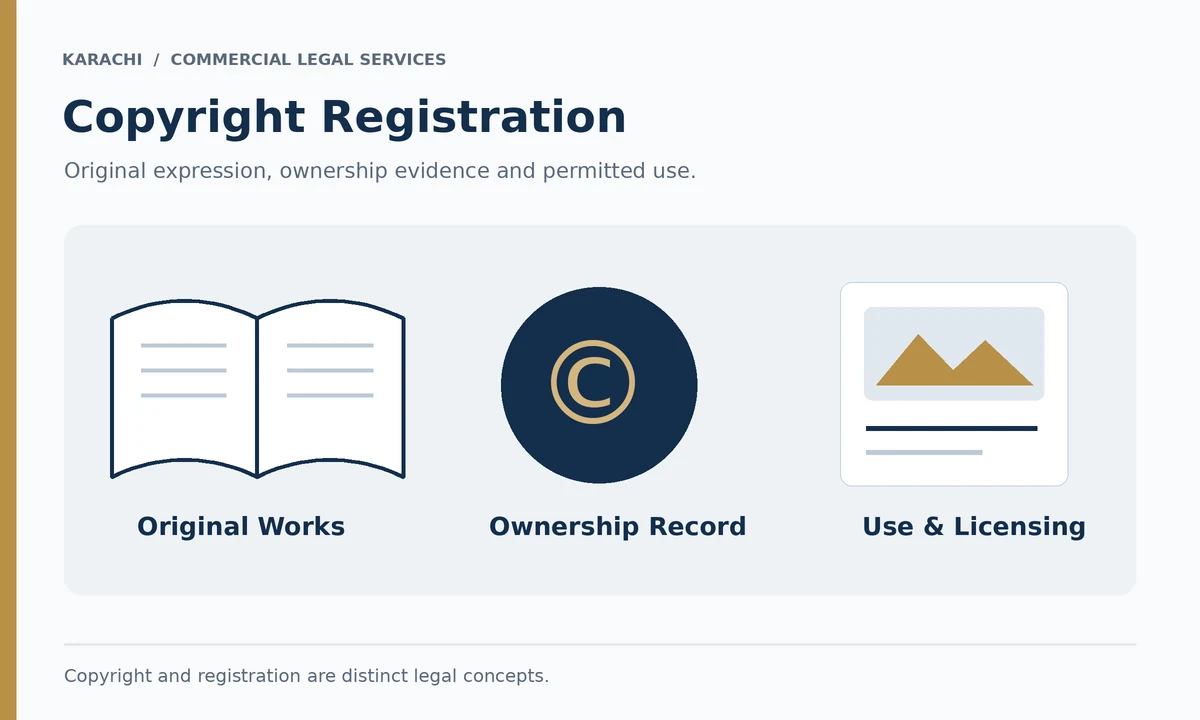
Legal Assistance With Copyright Registration in Karachi
Our office for Copyright Registration in Karachi assists with reviewing the work, identifying the applicant and preparing supporting records. Explain whether your project is a book, artwork, computer programme, recording or another category. The correct filing approach depends on those facts, not simply the commercial name you use for the project.
Applicants from Gulistan-e-Johar, Gulshan-e-Iqbal, Clifton, DHA and other Karachi localities can arrange an appointment at the office confirmed when booking. Bring the work and relevant agreements, rather than only a brief description.
Copyright Registration and Evidence for Creators
Copyright Registration can support a documented rights-management strategy. Keep dated drafts, source files, publication records and the agreements through which rights were acquired. These materials help explain the ownership claim if a licensee, distributor or alleged infringer questions it. Registration is evidence, not a guarantee that another party will never challenge the work or copy it.
Works Eligible for Copyright Registration in Karachi
Copyright protects qualifying original expression in legally recognised categories, including literary, dramatic, musical and artistic works, films and recordings. Computer programmes fall within the statutory definition of literary work. Copyright Registration should identify the particular work and its claimant accurately; a general business idea or commercial objective is not a substitute for the work itself.
Copyright Ownership, Copies and Licences
Copyright and ownership of a physical object are different. Buying a printed book or paying for a copy of a design does not, by itself, explain what reproduction rights were transferred. Before Copyright Registration, review who created the work, the circumstances of creation and any written assignment. A licence permits specified uses; an assignment transfers the rights identified in it.
Copyright Law and the Registration Framework
The Copyright Ordinance, 1962 governs the principal rights and registration framework in Pakistan. Sections 39 and 42 address registration and the evidentiary effect of entries and certificates. The register provides prima facie evidence of its particulars, not an unchallengeable declaration resolving every competing ownership claim.
Copyright Registration applications must also follow applicable rules and current Copyright Office requirements. Protection periods vary with the category and relevant dates, so a single blanket term should not be applied to every work.
Evidence and Ownership in Copyright Registration in Karachi
Copyright Registration provides an organised public record of the particulars submitted and accepted through the registration process. For a Karachi publisher, agency or software business, this can support negotiations and documentary due diligence. It does not remove the need to prove the underlying facts when a dispute arises.
Review older contracts before filing. If a company acquired a work from its founder or a contractor, the transfer documentation should be consistent with the applicant named in the application.

Accurate Applicants and Separate Contributions
Copyright Registration is most useful when the application matches the business’s real rights. List the author, claimed owner, publication history and relevant agreements consistently. Avoid describing an entire brand or collection as though every element has the same author and ownership history. Separate works or contributions may require separate consideration.
Benefits and Limits of Copyright Registration
The practical benefits of Copyright Registration include a recorded claim, clearer documentation for transactions and evidence that may assist enforcement. Registration does not promise statutory damages or automatic reimbursement of legal fees. Remedies depend on Pakistani law, the relief sought, the evidence and the decision of the competent forum.

Copyright Registration in Karachi and Enforcement Planning
Copyright Registration and enforcement are separate services. A filing engagement may cover preparation and registry correspondence without including notices, negotiation or litigation. If copying is already suspected, tell the lawyer immediately and preserve the evidence. Potential civil remedies can include injunctions and monetary relief where the statutory requirements are met; no outcome can be guaranteed.
The Process for Copyright Registration in Karachi
Copyright Registration begins with identifying the work and reviewing the applicant’s basis of ownership. The application, supporting material and applicable fee are then prepared for the Copyright Office. Examination, correspondence, objections and any applicable notice requirements must be handled according to the work’s category and the facts disclosed.
A filing receipt is not a final certificate. Retain copies of everything submitted and respond to official correspondence within the stated time.
Application Preparation and Artistic-Work Notices
Prepare a clear copy of the work, author and applicant particulars, publication details and the documents supporting ownership. Check the prescribed form and current filing requirements before submission. Copyright Registration should not proceed with conflicting names or an unexplained gap in the chain of ownership.
For artistic works, section 39 contains a newspaper-advertisement procedure. That requirement should not be presented as a universal step for every category. Confirm the applicable notice, objection and supporting-document requirements for your particular application.
Documents, Fees and Processing Expectations
The checklist for Copyright Registration depends on the work and applicant. The following records help prepare a case-specific filing plan; this is not a claim that every item is mandatory in every application.
| Record | Purpose |
|---|---|
| Copy and version of the work | Identifies what the application concerns. |
| Author and applicant details | Explains who created the work and who claims rights. |
| Publication information | Records relevant dates and places of publication. |
| Employment, assignment or licence documents | Supports the particular ownership or permission claimed. |
Ask for a written scope separating official charges, professional fees and additional dispute work. Current fees and processing expectations should be checked before filing; no fixed approval deadline is promised.
Copyright Infringement and Remedies
Copyright Registration does not make every similar work an infringement. The review must identify the protected material, the rights relied on, the alleged act and any permission or applicable exception. Preserve dated copies of the original and disputed material, website addresses, invoices and correspondence. Avoid altering the evidence after discovering suspected copying.
Assessing Alleged Copying and Exceptions
Unauthorised reproduction, distribution or other restricted uses may raise infringement issues, but the assessment is fact-sensitive. A lawyer should compare the actual works and consider the scope of the rights and any statutory defence. Copyright Registration can assist the evidence record; it cannot replace that analysis or guarantee immediate removal of disputed online content.
Copyright Registration in Karachi for Different Industries
Copyright Registration needs differ across publishing, advertising, software, music and media businesses. Identify the individual works and contributors within a commercial project. A campaign may contain photographs, scripts, music and graphic artwork owned or licensed by different people. One application’s description should not imply ownership of third-party material merely because it appears in the final product.
Creative Advertising and Brand Artwork
For an advertising campaign, Copyright Registration should focus on qualifying expression rather than an abstract marketing concept. Keep the creative brief, drafts, author details, client agreement and permissions for supplied assets. Where a logo also functions as a brand identifier, review trademark registration separately; copyright and trademark protection address different legal interests.
Sports Content and Media Rights
Sports businesses may deal with photographs, videos, promotional artwork and broadcast rights. These require careful separation: a team name is not automatically a copyright work, and a player’s image may raise issues beyond copyright. Copyright Registration advice should identify the actual creative material and the permissions held by the club, producer or advertiser.

Publishing, Manuscripts and Illustrations
Authors and publishers should review manuscripts, illustrations, translations and publishing agreements before Copyright Registration. The person publishing a book is not necessarily the owner of every contribution. Clarify print, digital, translation and territory rights in the agreement, and retain evidence of permissions for incorporated photographs, extracts or other third-party content.
Advertising Campaigns and Licensed Assets
Advertising agencies should not promise that Copyright Registration prevents all use of similar ideas. Review the original wording, artwork, film or music actually used, together with the client contract. A short slogan, brand name or product sign may require a different assessment. Licensing stock images or music also requires checking the permitted commercial uses.
Creative Firms and Contractor Agreements
Creative firms benefit from maintaining a rights register linking each project to its contributors and contracts. Before Copyright Registration, check whether employees, freelancers or subcontractors produced the assets and what rights the business acquired. Do not assume that a paid invoice explains every transfer. Clear records also help when a client requests source files or broader usage rights.
Software, Mobile Apps and Source Code
Software Copyright Registration concerns qualifying expression, including computer programmes, not every feature, function or business method in an application. Identify the relevant version, contributors and third-party components. Keep development and assignment records, and check open-source licence obligations. Avoid filing material belonging to a customer or contractor without a documented basis for the claim.
Commercial Uses of Creative Works
Copyright-based businesses earn income through publication, distribution, licensing and production services. The commercial value depends on the work, the rights held and the market, not merely on obtaining a certificate. Copyright Registration should therefore fit the wider business plan, including contract management, permissions and an evidence-preservation process.
Preparing a Reliable Copyright Application
Before seeking Copyright Registration, assemble a work-by-work record rather than a broad list of ideas. Identify unfinished drafts, final versions and material supplied by third parties. Tell the lawyer about existing objections or competing claims. Accurate disclosure helps avoid inconsistencies between the application, business contracts and evidence later relied on in a dispute.
The Business Value of Copyright Registration
Copyright Registration can support licensing and investment discussions, but a certificate is only one part of due diligence. A prospective licensee may also request the underlying contracts and publication history. A new business should keep company incorporation separate from ownership of its creative assets: forming the company does not automatically transfer a founder’s work into it.
Licensing, Assignments and Collaborations
Clear Copyright Registration records can help define the subject of licensing agreements and collaborations. Specify the permitted uses, territory, duration, payment arrangement and any right to sublicense. If the parties intend an assignment instead, document the rights being transferred. Do not describe permission to use a work as a transfer of all ownership.
Keeping Evidence After Registration
Copyright Registration should be followed by practical record-keeping, not treated as a promise that infringement will stop. Maintain originals, agreements, renewal or version records where relevant, and a record of authorised uses. For a suspected dispute, seek a case-specific assessment before sending allegations or starting proceedings. The appropriate response depends on the evidence and the rights actually held.
Karachi Office Appointments
Head Office: 2nd Floor, Supreme Corner, Johar Chowrangi, Gulistan-e-Johar, Karachi.
DHA Branch: 76-C, Mezzanine, Main Jami Commercial, Phase 7, DHA, Karachi.
Arrange a telephone appointment: +92 331 6644789 or WhatsApp. Please confirm the appointment location and office consultation fee when booking.
Copyright Registration Questions and Answers
Does Copyright Registration Prove Ownership?
Registration entries and certificates can provide prima facie evidence of the particulars recorded, but they are not conclusive proof of every ownership claim. Authorship, assignments and competing evidence may still require examination under the applicable copyright law.
Which Works Can Be Considered for Copyright Registration?
Describe the actual work, such as writing, artwork, music, a film or a recording, and explain who created it and when it was published. Eligibility and the appropriate application particulars depend on the work and the claimant's circumstances.
What Records Are Needed for Copyright Registration?
Preserve dated drafts, source files, publication details and correspondence concerning creation of the work. Include relevant employment, commissioning, assignment or licensing documents. Tell the lawyer about collaborators and competing claims before the applicant's details are finalised.
Can a Business Seek Copyright Registration for Commissioned Work?
Provide the commissioning agreement, invoice and communications about the rights intended to pass. Payment records alone do not explain every contractual arrangement. The lawyer should review the particular work and agreement before advising how the business should describe its ownership claim.
Is Logo Copyright Registration the Same as Trademark Registration?
They concern different forms of protection and should be reviewed separately. Explain whether you want advice about the artwork, the brand identifier, or both. A quotation and filing plan should identify the work and right being addressed.
How Much Does Copyright Registration Cost?
The cost depends on the work, application requirements and assistance needed. Request a written quotation separating current official filing charges from professional fees and any publication or document costs. Confirm whether responses to registry queries are included. No fixed fee is quoted here without checking the relevant application.
What Evidence Should I Preserve Alongside Copyright Registration?
Keep the original work, relevant dates, website addresses and copies of the material complained of. Record when the material was observed and preserve any correspondence. A lawyer can assess the evidence and possible response without assuming that a screenshot alone resolves the dispute.
How Long Does Copyright Registration Take?
Timing depends on the work category, complete application documents, applicable publication requirements and any registry queries or objections. Ask for an estimate after the documents have been reviewed, and distinguish preparation time from registry processing. A filing receipt is not a registration certificate, and no guaranteed completion date is promised.
Does Copyright Registration Provide Automatic Worldwide Protection?
Explain where the work was created, first published and used, and identify the countries relevant to the proposed transaction or dispute. International protection and enforcement should be assessed for those facts rather than described as an automatic worldwide registration.
Does Copyright Registration Assistance Include an Infringement Case?
Confirm whether the engagement covers document review, application preparation, registry correspondence or a separate dispute. Notices, negotiations and court proceedings should be scoped expressly. This allows the applicant to understand the work included before instructions are given.
Last Updated: 23 October 2026