What court marriage in Karachi actually means
Under Muslim personal law, a valid Nikah needs an offer and acceptance (ijab-o-qabool) by the two parties, given freely, in the presence of two adult Muslim witnesses, with a dower (haq mehr) agreed or presumed. The word "court" refers to the documentation lawyers prepare so that the marriage can be proved later — for example a sworn statement by each party that they are marrying of their own free will.
A court marriage is therefore not a separate kind of marriage and it is not a shortcut around the law. It is a Nikah like any other, carried out with legal safeguards because the couple may face family opposition or simply want a quiet, properly recorded ceremony.
Who can have a court marriage in Karachi
The minimum age in Sindh is 18 for both parties
The Sindh Child Marriages Restraint Act 2013 sets 18 years as the minimum age for both the man and the woman. Arranging, solemnising or performing a marriage where either party is under 18 is an offence in Sindh. We only act for adults, and we check age from the CNIC or other official record before anything is prepared.
Free consent of an adult woman
Superior courts in Pakistan, in the line of cases including Hafiz Abdul Waheed v. Asma Jahangir (the Saima Waheed case), have held that an adult Muslim woman can contract her own Nikah without the permission of a wali (guardian). Family approval is always worth seeking where it is safe to do so, but its absence does not by itself invalidate a Nikah between consenting adults.
If either party has been married before
A divorced woman should have proof that the earlier marriage ended and that her iddat is complete — usually a Union Council certificate that the talaq became effective, or a Family Court decree. A married man who wishes to marry again must first obtain permission from the Arbitration Council under section 6 of the Muslim Family Laws Ordinance 1961. Marrying without that permission is a punishable offence and can give the existing wife grounds to seek dissolution.
Documents for court marriage in Karachi
Bring originals and photocopies of the following. If something is missing, tell us before the appointment rather than on the day.
- CNIC of the bride and the groom (or passport for a foreign national).
- Two adult Muslim witnesses with their CNICs.
- Recent passport-size photographs of both parties.
- Proof that any earlier marriage has ended (divorce certificate or court decree), where relevant.
- Arbitration Council permission, if the groom is already married.
- For a foreign spouse: passport, visa or entry record, and any document their own country requires — we explain this separately.
Step-by-step process for court marriage in Karachi
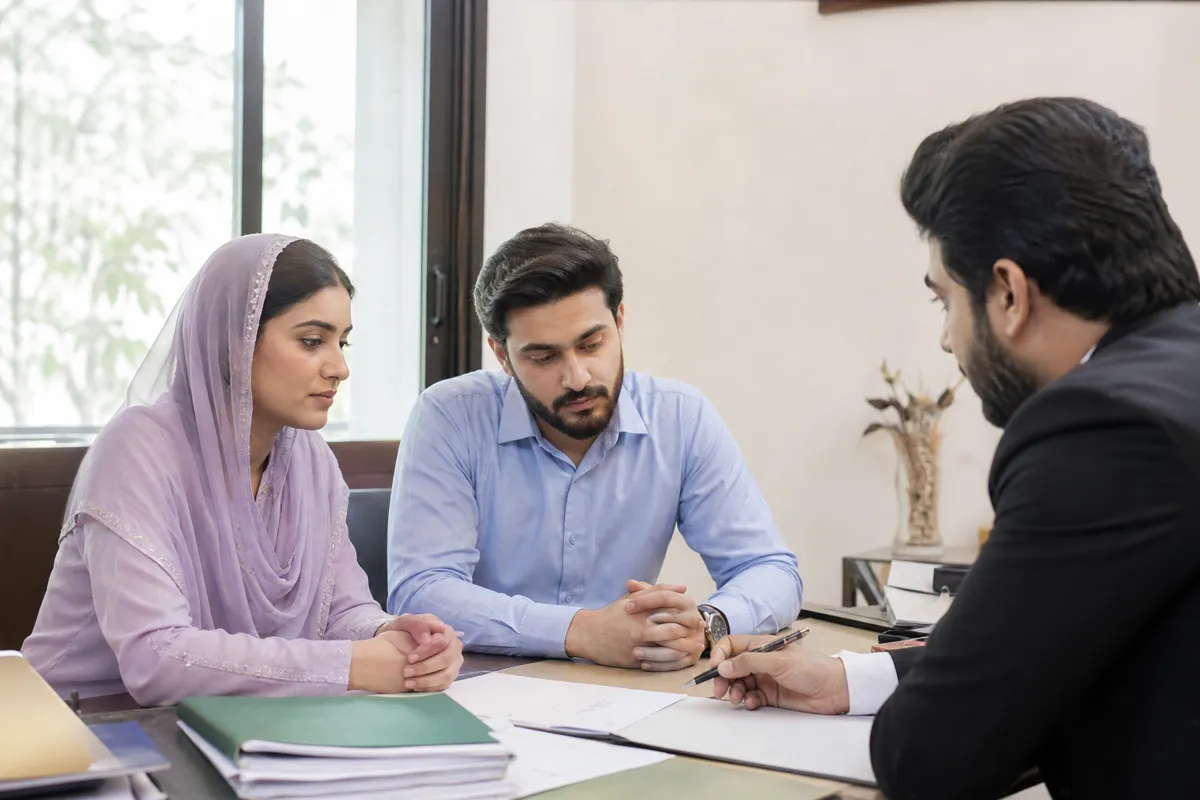
- Initial discussion on WhatsApp or at the office: we confirm ages, marital status and the documents available.
- Free-will affidavits: each party signs a sworn statement that they are adult, unmarried (or lawfully able to marry) and marrying by choice.
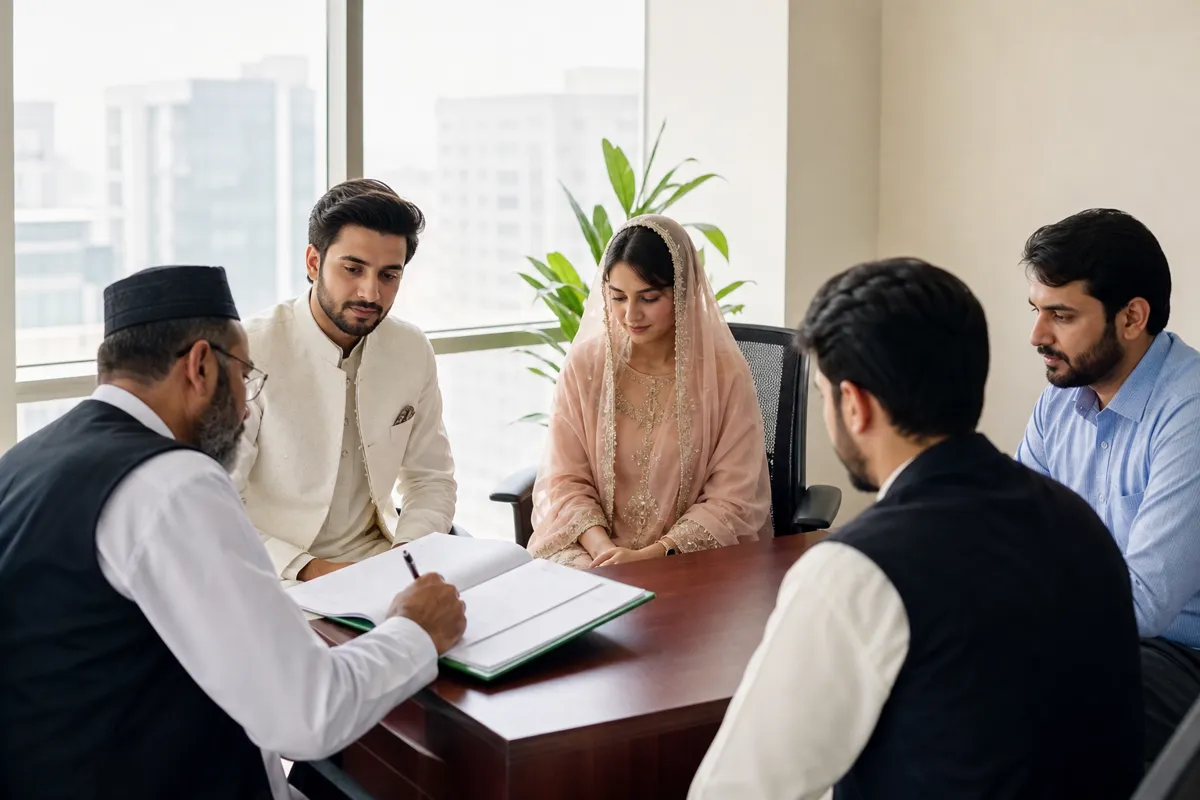
- Nikah: a licensed Nikah Registrar or maulana conducts the ijab-o-qabool in front of the two witnesses, and the dower is recorded.
- Nikah Nama: every column of the prescribed form is completed and signed — including dower, any delegated right of divorce and the existing-wife declaration. See our Nikah Nama guide.
- Registration: the Nikah Registrar registers the Nikah with the relevant Union Council under section 5 of the MFLO 1961.
- Certificates: once registered, a computerised NADRA marriage certificate can be obtained through the Union Council.
Timing depends on the documents, the Nikah Registrar and the Union Council, so we do not promise a fixed turnaround. We will give you a realistic estimate once we have seen the papers.
Why couples choose our court marriage lawyers in Karachi
Office Nikah, not a courtroom
The Nikah is performed at our office by a Nikah Registrar, in a calm and private setting.
Correct Nikah Nama
We go through every column with you so that dower, conditions and declarations are recorded properly.
Registration followed through
We track Union Council registration so the marriage can be proved and a NADRA certificate issued.
Two offices in Karachi
Gulistan-e-Jauhar for central and east Karachi, and DHA Phase 7 for clients in the south.
Honest advice
If something in your situation needs resolving first — an earlier marriage, an age question — we say so.
WhatsApp first
Most clients start on WhatsApp at +92 333 1127830. Email is available but slower.
Safety, family pressure and protection after a Court Marriage in Karachi
Some couples who arrange a court marriage are worried about threats from relatives. A valid Nikah does not, by itself, protect anyone from harassment, so we discuss practical steps: keeping certified copies of the Nikah Nama and affidavits, informing the police where there is a genuine threat, and, where necessary, applying to the court for protection. These steps depend on facts and are assessed case by case.
Where a family files a complaint alleging abduction, the documents prepared at the time of the Nikah — and the woman's own statement before a magistrate if required — are often what resolves the matter. Keep them safe.
Court marriage in Karachi for overseas Pakistanis and foreign nationals
Many couples include one spouse who lives abroad or is a foreign national. The Nikah itself follows the same rules, but the paperwork afterwards often matters more: embassies and immigration authorities may ask for the Nikah Nama, the NADRA marriage certificate and attestation by the Ministry of Foreign Affairs. If one party cannot travel, read about online Nikah in Karachi and its limits.
Couples who want to understand the general court marriage procedure in Urdu can read it on our partner site, and families arranging a ceremony afterwards can look at Nikah Khawan services. Those who cannot travel may prefer online Nikah services.
Non-Muslim marriages are governed by different laws
This page concerns Muslim marriages. Marriages between Christians are governed by the Christian Marriage Act 1872, and Hindu marriages in Sindh by the Sindh Hindu Marriage Act 2016. Different rules apply where the parties belong to different faiths; please speak to us directly rather than relying on general information.
Court marriage in Karachi compared with a traditional family Nikah
Legally, both are the same Nikah. The differences lie in setting and paperwork.
| Point | Court marriage (office Nikah) | Traditional family Nikah |
|---|---|---|
| Venue | Law office, with a Nikah Registrar | Home, mosque or wedding hall |
| Consent record | Separate free-will affidavits by both parties | Usually oral, before family and witnesses |
| Witnesses | Two adult Muslim witnesses | Two adult Muslim witnesses, often relatives |
| Registration | Union Council under MFLO s.5 | Union Council under MFLO s.5 |
| Legal validity | Same as any valid Nikah | Same as any valid Nikah |
After the Nikah: practical next steps
- Keep the original free-will affidavits and the registered Nikah Nama in a safe place.
- Obtain certified copies for each spouse.
- Apply for the computerised marriage certificate once registration is entered.
- Update CNIC marital status if you wish.
Choosing a lawyer for your Nikah
Couples planning a court marriage should choose a firm that explains the law, checks documents and follows registration through. A court marriage arranged carelessly can leave the couple without a registered Nikah or with a Nikah Nama full of errors. With our team, every court marriage is handled at our own office with a licensed Nikah Registrar.
Our standards for every court marriage
- Adults aged 18 or over only, checked from the CNIC.
- Separate confirmation of each party's free consent.
- No false entries or back-dated documents.
- Honest estimates instead of guaranteed timelines.
These standards apply to every court marriage we arrange.
Court marriage outside Karachi
Our Karachi team coordinates matters in other cities through associate lawyers. See court marriage in Islamabad and Rawalpindi and court marriage in Multan. For a wider national guide, our sister site Court-Marriage.com covers the process across Pakistan.
Frequently asked questions
Does a court marriage take place in court?
No. The Nikah is performed at a law office by a Nikah Registrar or maulana. "Court marriage" refers to the legal documentation, not the venue.
Is a court marriage legally valid?
Yes, if the essentials of a Muslim Nikah are met — free consent of adult parties, two adult Muslim witnesses and dower — and the marriage is registered under section 5 of the MFLO 1961.
Do we need our parents' permission?
An adult Muslim woman does not need a wali's permission to marry, according to the Saima Waheed line of cases. Both parties must be at least 18 in Sindh.
Can a married man have a court marriage?
Only after obtaining Arbitration Council permission under section 6 of the MFLO 1961. Without it, the marriage exposes him to prosecution and gives the existing wife legal remedies.
How long does it take?
It depends on documents and Union Council registration. We give an estimate after reviewing your papers rather than a guarantee.
How do we start?
Send both names, ages and marital status on WhatsApp to +92 333 1127830, or visit our Gulistan-e-Jauhar or DHA office by appointment.
Can the bride appoint a vakil?
Yes, but an adult woman may also give consent herself. A vakil is a convenience, not a requirement.
Do the witnesses have to be relatives?
No. Any two adult Muslim witnesses who hear the offer and acceptance may act.
Can a court marriage be kept private?
The Nikah is registered, so it is a public record, but the ceremony itself can be small and private.
Can we hold a family ceremony later?
Yes. A later rukhsati or walima does not require a second Nikah.
Speak to Karachi Lawyers about Court Marriage in Karachi
Karachi Lawyers has practised since 1985 and has about 17 advocates, including two Advocates Supreme Court. Send a WhatsApp message to +92 333 1127830 with your name, a two-line summary of the matter, any deadline or hearing date, and photos of the key documents. We will tell you what the law requires, which documents are missing and what the next step is, and fix an appointment at our Gulistan-e-Jauhar office (Mezzanine Floor, Muneer Mobile Mall, Block 17) or our DHA office (Mezzanine Floor, Main Jami Commercial, Phase 7). We explain the scope of work before you instruct us, and we never promise an outcome we cannot control.
Related services from Karachi Lawyers
Official sources
For reference only. Procedures and charges change; confirm the current position for your own case.
This page gives general information about the law in Pakistan and is not legal advice for your particular case. No outcome, timeline or fee can be guaranteed before your documents and circumstances have been reviewed.
Reviewed by: Syed Mohsin Ali Shah, Senior Consulting Lawyer
Published by: Karachi Lawyers
Last updated: