
Family Laws in Pakistan: A Guide to Marriage, Divorce, and Legal Rights
Navigating the legal landscape of family matters in Pakistan requires a delicate balance of religious tradition and contemporary statutory law. At our firm, we understand that family disputes—whether involving child custody, the dissolution of marriage, or financial maintenance—are among the most sensitive challenges an individual can face.
Our legal experts provide dedicated representation in Pakistan’s Family Courts, ensuring that your rights are upheld in matters of:
- Dissolution of Marriage: Including Khula (judicial divorce) and Mutual Divorce (Talaq-e-Mubarat).
- Financial Security: Alimony, maintenance for wives and children, and recovery of dower (Mahr).
- Child Welfare: Legal custody, guardianship, and visitation rights.
- Protective Litigation: Domestic violence injunctions and recovery of dowry articles.
- Civil Matters: Court marriage, adoption guidance, and inheritance distribution.
The Framework of Pakistani Family Law
The legal system in Pakistan is designed to safeguard the vulnerable, specifically prioritizing the welfare of women and children. By combining Islamic Jurisprudence with modern ordinances like the Muslim Family Laws Ordinance (1961), the state provides a transparent mechanism for resolving domestic conflicts. Whether you are seeking a graceful exit from a marriage or fighting for the support of your children, understanding these statutes is the first step toward justice.
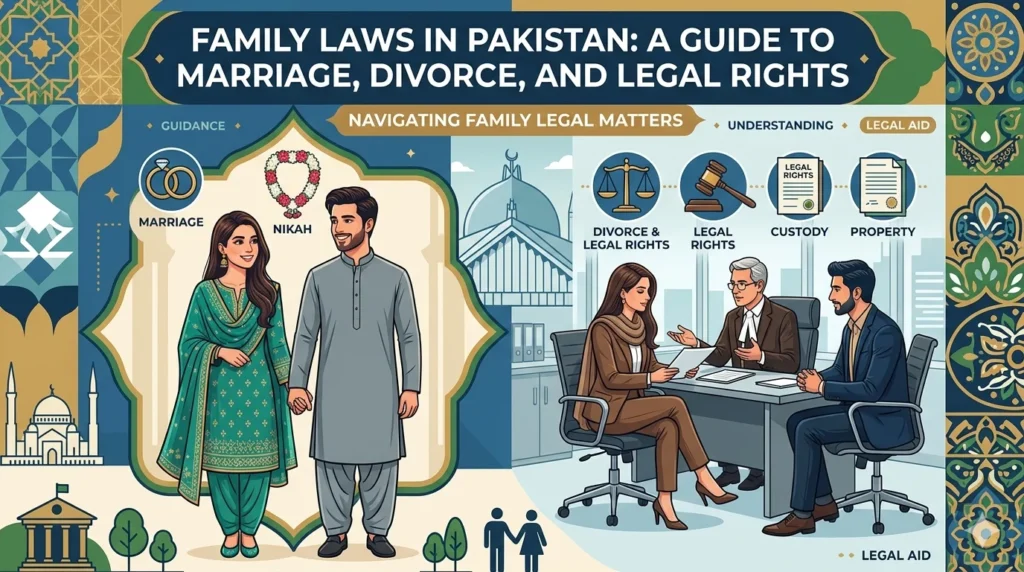
Key Statutes Governing Family Relations in Pakistan
1. Muslim Family Laws Ordinance (MFLO), 1961
The MFLO is the primary document regulating Muslim domestic life. It revolutionized family law by mandating the registration of Nikah and divorces, making them a matter of public record. It also provides essential protections against unmonitored polygamy by requiring a husband to seek permission from an Arbitration Council before contracting a second marriage.
2. West Pakistan Family Courts Act, 1964
To prevent family matters from languishing in standard civil courts, this Act established Specialized Family Courts. These forums are designed for efficiency, focusing on the swift resolution of cases involving dower, maintenance, and the restitution of conjugal rights.
3. Guardian and Wards Act, 1890
When a marriage ends, the future of the children is paramount. This Act governs the appointment of guardians. The overriding principle used by Pakistani courts under this law is the “Welfare of the Minor,” ensuring that custody decisions are based on the child’s best interests rather than a parent’s demands.
4. Dissolution of Muslim Marriages Act, 1939
This landmark legislation empowers Muslim women to seek a judicial divorce (Khula) on specific legal grounds. These include, but are not limited to, cruelty, desertion for more than four years, or the husband’s failure to provide financial maintenance.
5. Child Marriage Restraint Act, 1929
This act serves as a social and legal safeguard, setting the minimum age for marriage (typically 18 for males and 16 for females, though some provincial variations apply). It criminalizes the facilitation of underage unions to protect the health and educational rights of the youth.
6. The Dowry and Bridal Gifts (Restriction) Act, 1976
Recognizing the financial strain often placed on a bride’s family, this law sets a legal ceiling on the value of dowry and bridal gifts. It is frequently invoked in court to help women recover their personal belongings and “Jahez” articles after a separation.
7. Domestic Violence (Prevention and Protection) Act, 2013
Modern Pakistani law recognizes that “family matters” should never include abuse. This Act provides a robust definition of domestic violence—including emotional and economic abuse—and allows victims to obtain protection orders to bar abusers from their presence.
8. Minority Marriage Acts (Christian 1872 & Hindu 2017)
Pakistan provides dedicated legal frameworks for its minority communities. The Christian Marriage Act regulates church solemnization and registration, while the Hindu Marriage Act of 2017 was a historic step in finally providing Hindu citizens with a formal mechanism to register their unions and seek legal divorce.
Why Legal Representation Matters
Family law cases are won or lost on the strength of documentation and procedural accuracy. From filing the correct affidavits to navigating the Arbitration Council, having a seasoned family lawyer ensures that your voice is heard and your future is protected.
Frequently Asked Questions (FAQ)
Yes. Under the Dissolution of Muslim Marriages Act (1939), a woman can seek Khula (judicial divorce) through the Family Court. While she may have to forego some or all of her dower (Mahr), she does not require the husband’s permission if she can demonstrate that they can no longer live within the “limits prescribed by Allah.”
While the West Pakistan Family Courts Act (1964) mandates a swift process, the duration depends on the nature of the case. A Khula or Mutual Divorce can often be finalized within a few months, whereas contested Child Custody or Maintenance cases may take longer depending on evidence and witness testimonies.
- Nikah Nama: The primary Islamic contract signed at the time of the wedding. It contains the terms of the marriage (Dower, right of divorce, etc.).
- NADRA Certificate: A computerized document issued by the Union Council based on the Nikah Nama. This is the official document required for passports, visas, and banking.
In Pakistan, the court follows the principle of Hizanat (the right of the mother to physical custody) for younger children. However, the father remains the Natural Guardian. Ultimately, the court decides based on the “Welfare of the Minor,” considering which parent can better provide for the child’s emotional and physical needs.
Under the Muslim Family Laws Ordinance (1961), a man must obtain written permission from the Arbitration Council (and ideally his first wife) before contracting a second marriage. Failure to do so can lead to legal penalties, including fines or imprisonment, though the second marriage itself remains technically valid under Sharia.
Understanding the Legal Roadmap
Navigating the court system can feel overwhelming. Below is a simplified view of how a family law matter typically progresses through the Pakistani judicial system:
The 4-Step Legal Journey:
- Filing the Petition: Your legal counsel submits a formal claim (e.g., for Maintenance or Khula) to the Family Court.
- Summoning & Response: The court issues a notice to the other party to submit their written reply.
- Pre-Trial Reconciliation: The Judge attempts to mediate between the parties to see if an out-of-court settlement is possible.
- Evidence & Decree: If reconciliation fails, the court records evidence, hears arguments, and issues a final binding Decree.