

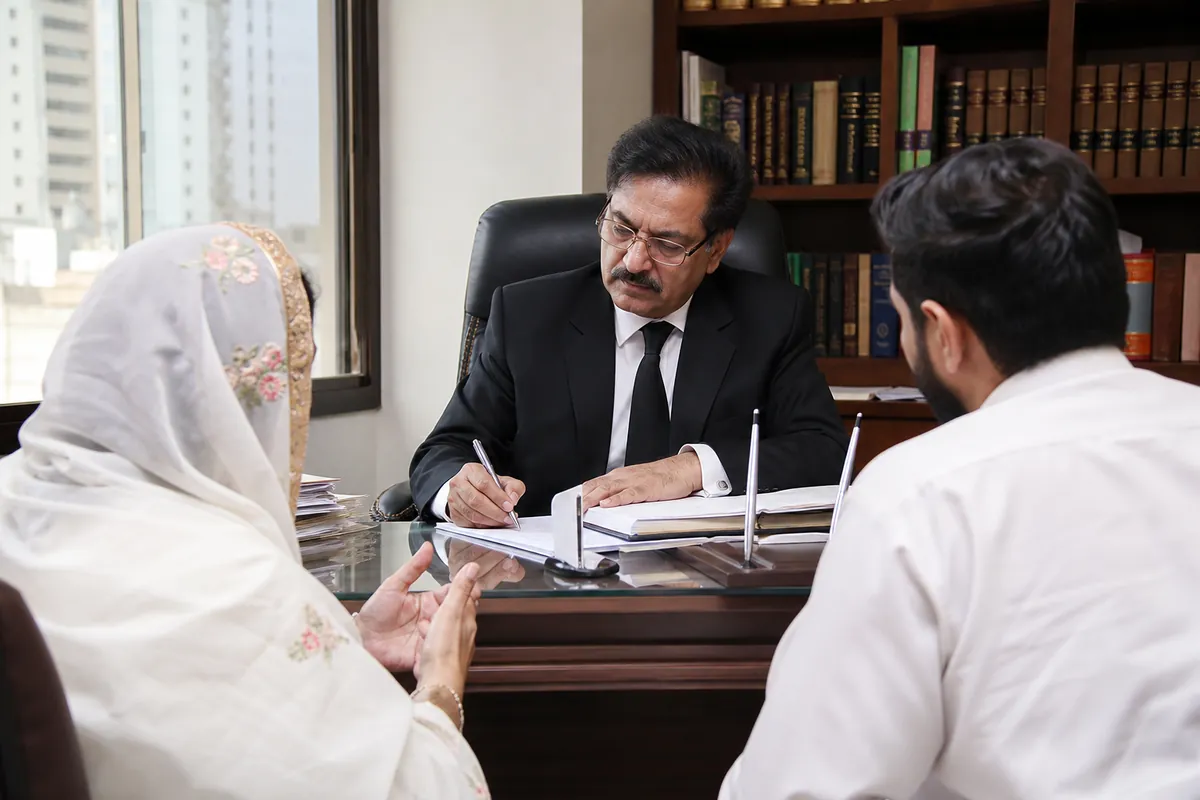
Executive Summary: Family Law Consultation in Karachi Essentials
What the service is
A focused meeting in which a family lawyer reviews your documents, asks the questions that matter legally, explains your rights and the other side’s likely position, and sets out the realistic options with their timeframes and risks, followed by a short written note.
Who needs it
Anyone facing separation, divorce or khula, a wife seeking maintenance or dower, a parent worried about custody or meetings, someone served with a family suit or talaq notice, and overseas Pakistanis who need advice before travelling.
How the fee is set
The consultation fee is quoted when you book, after we see the documents and the summary. If you then instruct us on a case, the fee for that work is quoted separately after the full documents are reviewed. We do not publish fee figures.
How long it usually takes
Most first consultations take under an hour when documents are sent in advance. The written note of options normally follows within a few working days. Where urgent action is needed, such as an imminent hearing, we say so during the meeting.
How to start
Send copies of every relevant document and a one-page summary of the facts on WhatsApp. We confirm the lawyer, the date, whether the meeting is in person or by video, and the consultation fee.
Advocate-led since 1985
Family consultations at our practice are led by an Advocate Supreme Court with a dedicated family-law expert. The same team that gives the advice can take the case into the Family Court and, if needed, onward to appeal.
What Happens in a First Family Law Consultation in Karachi
- The lawyer reads your summary and documents before you arrive.
- You explain what has happened and what outcome you want.
- The lawyer asks focused questions on dates, children, dower, property and earlier proceedings.
- Your rights and the other side’s likely position are explained plainly.
- Options are compared — negotiation, Union Council, Family Court or no action yet.
- You leave knowing the recommended route, the documents still needed and the next step.
Documents to Bring to a Family Law Consultation in Karachi
- Nikah Nama (and the NADRA marriage certificate if available).
- CNICs of both spouses and the children’s birth certificates or B-Forms.
- Any talaq notice, khula papers, Union Council notices or divorce certificate.
- Any suit, plaint, summons or order already received from a Family Court.
- Evidence of income, expenses and maintenance paid or unpaid.
- A list of dowry articles and bridal gifts, with receipts or photographs.
- Messages or letters that show the key events, printed with dates.
Preparing for the Meeting
Write a One-Page Summary First
A single page saves time and money. Write the date of marriage, the number and ages of children, when the problem began, what each side has done since, and what you want. Keep it factual and in date order. Lawyers can then use the meeting for advice rather than for collecting basic facts.
How We Protect Your Documents
Bring copies rather than originals unless we ask for them. Originals of the Nikah Nama, receipts for dowry articles and property papers should stay in a safe place. If originals are needed for filing, we record what we receive and return them once the court has seen them.
Advice, Timeframes and Next Steps
How Advice Is Given
Advice is given in plain language, in Urdu or English, during the meeting. Afterwards you receive a short written note listing your options, the route we recommend, the documents still needed and the likely stages. The note is yours to keep, whether or not you instruct us on the case.
Understanding Timeframes and Costs
At the end of the meeting we explain the likely stages of the recommended route — notice periods, hearings, evidence and judgment — and give realistic ranges rather than promises. If you instruct us, the case fee is quoted in writing after the full documents are reviewed, so there are no surprises later.
After the Consultation
Some clients need no case at all — a letter or a Union Council step resolves matters. Others need a suit filed promptly to protect a right. If you instruct us, we quote the case fee after reviewing the full documents, prepare the pleadings and keep you informed at each hearing.
Choosing the Right Route After Family Law Consultation in Karachi
| Problem | Usual route | Forum |
|---|---|---|
| Wife wants to end the marriage | Khula or dissolution suit | Family Court |
| Husband intends divorce | Talaq with written notice under the 1961 Ordinance | Chairman, Union Council |
| Unpaid maintenance | Maintenance suit, or Arbitration Council application | Family Court or Union Council |
| Unpaid dower or dowry articles | Suit for dower and recovery of dowry | Family Court |
| Custody or meetings with a child | Guardianship and meeting application | Family Court as Guardian Court |
| Second marriage by husband | Permission or complaint under the 1961 Ordinance | Arbitration Council |

Questions Asked at a Family Law Consultation in Karachi
Marriage details
Date of Nikah, dower amount, and whether it was prompt or deferred.
Children
Names, ages, schooling and who they live with now.
Separation
When you separated and who left the matrimonial home.
Money
Income of each spouse and any maintenance paid.
Property
Dowry articles, gifts, jewellery and jointly used property.
Earlier steps
Notices, Union Council proceedings or suits already filed.
Format of the Meeting
Confidentiality and Who Attends
What you tell us stays confidential. You may bring one trusted relative, but we may ask to speak to you alone for part of the meeting, particularly in khula or custody matters where pressure from family is possible. Women clients can ask for the consultation to be led by our family-law expert.
Family Law Consultation in Karachi by Video
Clients abroad or unable to travel can consult by video. Send documents in advance as clear scans. The format is the same as an office meeting, and the written note follows in the same way. If a case is then filed, we can act through a power of attorney attested abroad.
Language and Accessibility
Meetings are held in Urdu or English, whichever you prefer, and documents in either language are reviewed. Elderly clients or those with mobility needs can ask for a video meeting or for a family member to help them attend in person.
Situations We Often Advise On
Urgent Matters We Prioritise
Some situations cannot wait for an ordinary appointment: a hearing date within days, a threat to remove children from Karachi, a talaq notice already served, or pressure to sign documents. Tell us on WhatsApp when you book, and we will try to arrange the earliest available meeting with a senior lawyer.
Advice for Husbands as Well as Wives
We advise both spouses, though never both sides of the same dispute. Husbands often consult about lawful talaq, maintenance they can realistically pay, meetings with children or defending a suit for dower. Clear early advice avoids mistakes that later cost far more in court.
When a Second Opinion Helps
Clients sometimes come to us with a case already filed by another lawyer. We can review the pleadings, orders and hearing record, explain where the case stands and whether anything needs correcting. Bring the complete court file, including the latest order sheet, to make that review useful.
Settlement Before Litigation
Many family disputes are best resolved by negotiation, with the agreement recorded in writing or before the court. The Family Court itself attempts reconciliation before and after trial. We tell you honestly when settlement is likely to serve you better than a long contested case.
Mistakes to Avoid Before Getting Advice
- Signing any compromise, affidavit or stamp paper presented by the other family.
- Leaving behind original documents, jewellery records or dowry receipts.
- Pronouncing or accepting talaq informally without the written notice the law requires.
- Taking children abroad or refusing all contact without legal advice.
- Ignoring a court summons because you hope the matter will settle.
Related Family Pages
For representation in court see family and divorce lawyers in Karachi and specialised family lawyers. For specific topics, read about the talaq procedure in Pakistan, visitation rights and khula and dower recovery.
Book a Family Law Consultation in Karachi
Send your one-page summary and copies of your documents on WhatsApp to +92 333 1127830. We will confirm the lawyer, the date and whether you meet us at Gulistan-e-Jauhar, DHA or by video, and quote the consultation fee before you come.
Frequently asked questions
What should I bring to a first family-law meeting?
Your Nikah Nama, CNICs, children’s birth certificates or B-Forms, any notices or court papers, evidence of income and maintenance, a list of dowry articles, and a one-page summary of events in date order.
Why do you ask for a one-page summary?
It lets the lawyer understand the facts before you arrive, so the meeting is spent on advice rather than collecting basics. Keep it factual, in date order, and say clearly what outcome you are hoping for.
Will I get advice in writing?
Yes. After the meeting you receive a short note setting out your options, the route we recommend, the documents still needed and the likely stages. It is yours to keep whether or not you instruct us.
Can I consult by video from abroad?
Yes. Send clear scans beforehand and we hold the meeting by video in the same format as an office consultation. If a case is needed, we can act for you through a power of attorney attested abroad.
Is everything I say confidential?
Yes. Your information is kept confidential. You may bring a relative, but the lawyer may wish to speak to you alone for part of the meeting, particularly where family pressure is possible.
Who will I meet?
Consultations are led by Syed Akhtar Rizvi, Advocate Supreme Court, and Sobia Mohsin, Family Law Expert. Women clients may ask for the meeting to be led by our family-law expert.
Do I have to file a case after consulting?
No. Sometimes a letter, a Union Council step or simply waiting is the right advice. If a case is needed, we explain why and quote the case fee separately after reviewing the full documents.
How is the consultation fee decided?
It is quoted when you book, after we see the summary and documents. The fee for any case that follows is quoted separately. We do not publish fee figures on the website.
Can you advise on both khula and custody together?
Yes. Most family problems involve several issues — dissolution, dower, maintenance, dowry articles and children. A good consultation looks at them together so that one step does not damage another.
What if I have already received a court summons?
Bring it to the consultation as soon as possible and tell us the hearing date. Family Court timelines are strict, and appearing on time protects your position while the options are considered.
Speak to Karachi Lawyers about Family Law Consultation in Karachi
Karachi Lawyers has practised since 1985 and has about 17 advocates, including two Advocates Supreme Court. Send a WhatsApp message to +92 333 1127830 with your name, a two-line summary of the matter, any deadline or hearing date, and photos of the key documents. We will tell you what the law requires, which documents are missing and what the next step is, and fix an appointment at our Gulistan-e-Jauhar office (Mezzanine Floor, Muneer Mobile Mall, Block 17) or our DHA office (Mezzanine Floor, Main Jami Commercial, Phase 7). We explain the scope of work before you instruct us, and we never promise an outcome we cannot control.
Related services from Karachi Lawyers
Official sources
For reference only. Procedures and charges change; confirm the current position for your own case.
This page gives general information about the law in Pakistan and is not legal advice for your particular case. No outcome, timeline or fee can be guaranteed before your documents and circumstances have been reviewed.
Reviewed by: Syed Akhtar Rizvi, Advocate Supreme Court
Published by: Karachi Lawyers
Last updated: